


Background
Since being designated as a State University with Legal Entity (PTN BH), Universitas Sumatera Utara (USU) has developed a Long-Term Plan (RJP) for 2015–2039, divided into five five-year Strategic Plans (Renstra). USU recently completed Phase I (2015–2019), which aimed to position USU as a leading national university with the highest accreditation and initial steps toward international recognition. Entering Phase II (2020–2024), USU refined its ideal vision to become an internationally standardized university with local excellence. One key benchmark of an international-standard university is its inclusion in the Top 500 World University Rankings (WUR), particularly the Quacquarelli Symonds (QS) WUR ranking system. The 2020–2024 Strategic Plan aligns USU's objectives with the Indonesian Ministry of Education and Culture (Kemendikbud) 's goal of having six Indonesian universities ranked in the Top 500 QS-WUR by 2024. To achieve this, 16 Indonesian universities, including USU, have been prepared to meet this target, highlighting the synergy between USU's strategic plan and the 2020–2024 National Higher Education Roadmap. USU has implemented a series of strategic programs to accelerate its internationalization efforts and enhance its performance according to QS Ranking parameters. One key parameter is Internationalization, which considers the number of international students and faculty members at a university and the participation of its own students and faculty in foreign institutions. USU's current Internationalization score remains suboptimal, indicating the need to increase inbound mobility (international students and faculty coming to USU) and outbound mobility (USU students and faculty engaging in activities abroad). USU has developed various inbound and outbound programs beyond government-initiated exchange programs like IISMA (Indonesian International Student Mobility Awards) and Staff Mobility to address this. Some of USU's outbound initiatives include student and faculty exchanges, humanitarian projects, and sabbatical leave programs. For inbound mobility, USU has introduced programs such as summer courses, team teaching, guest lectures, Top Scientist events, and postdoctoral fellowships. Enhancing staff and student mobility is crucial for strengthening Internationalization and enriching the learning atmosphere at USU. This initiative also directly improves USU's global reputation as a world-class university with local excellence. USU is taking progressive steps to enhance cross-cultural learning and skill development among students to support Internationalization fully. This aligns with the university's "Transformation Toward the Ultimate" vision, which aims to reinforce international academic collaborations through student exchanges (both inbound and outbound). Inbound and outbound mobility programs are also designed to improve educational quality and prepare students for global challenges. Cultural diversity, knowledge exchange, and cross-cultural skills are vital in shaping students into globally minded change agents. Student exchanges serve as a key initiative to broaden students' academic perspectives and learning experiences.
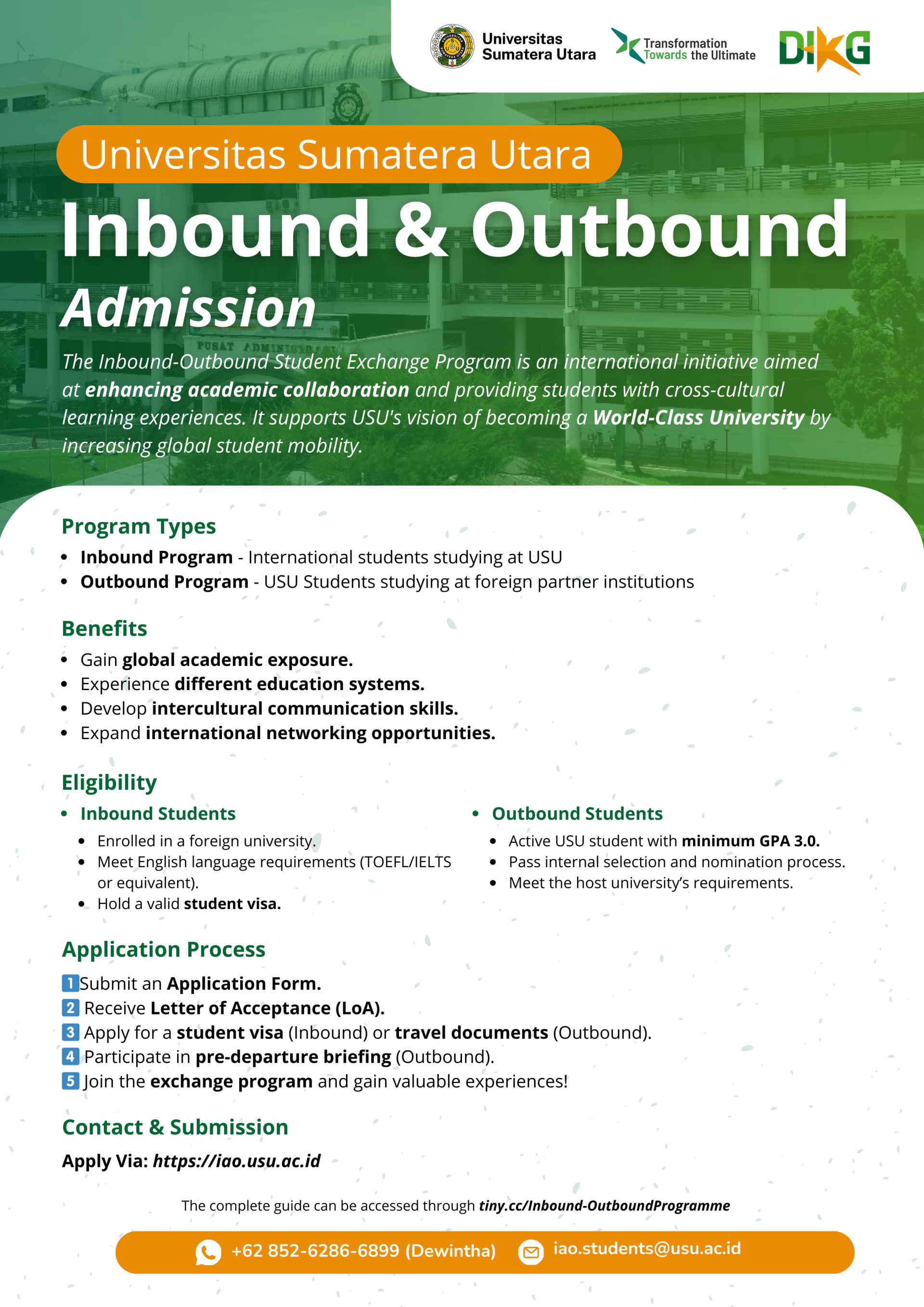
Program Mechanism
For more detailed information, please refer to the following guide:
http://tiny.cc/Inbound-OutboundProgramme
Program Objectives
The Inbound and Outbound Student Exchange Program aims to:
1. Provide students with experiential learning opportunities by exposing them to different academic environments outside their home institutions, enhancing hard skills include problem-solving in industrial settings, analytical skills, and technical expertise and cross-cultural competencies enable students to understand different teaching methods, learning approaches, and research focuses across various countries.
2. Develop foreign language proficiency, helping students interact in multilingual and multicultural environments to support further studies, career advancement, and global engagement.
3. Enhance academic specialization, allowing students to explore subjects aligned with their academic and career interests.
4. Cultivate intercultural skills by engaging with faculty and peers from diverse backgrounds, fostering a better understanding of cultural diversity and improving cross-cultural communication.
5. Build international networks to benefit students in further studies, collaborative research, and future career opportunities.
6. Strengthen teaching methodologies and academic environments at both the host and home universities.
7. Enhance institutional Internationalization by expanding global partnerships.
8. Improve higher education quality by strengthening each university's comparative and competitive advantages.
9. Reduce educational disparities between domestic and international universities.
phone
DEWINTHA: +62 852-6286-6899
