


Medan, April 14, 2026 — Universitas Sumatera Utara (USU), through its Directorate of Partnership and Internationalization (DIKG), received an official visit from Coca-Cola Europacific Partners (CCEP) Indonesia to explore opportunities for strategic collaboration in the development of green skills and sustainable entrepreneurship.
The hybrid meeting was held at the Equity Meeting Room, 3rd Floor of the USU Rectorate Building, with additional participants joining online. The session was attended by the Director of DIKG USU, Prof. Dr. dr. Dewi Masyithah Darlan, DAP&E., MPH., Sp.Park, along with the Partnership Manager, Amalia Meutia, M.Psi., Psikolog. Representing CCEP Indonesia were Yayan Sopian, Regional Public Affairs Manager, and Agnes, Sustainability Manager.
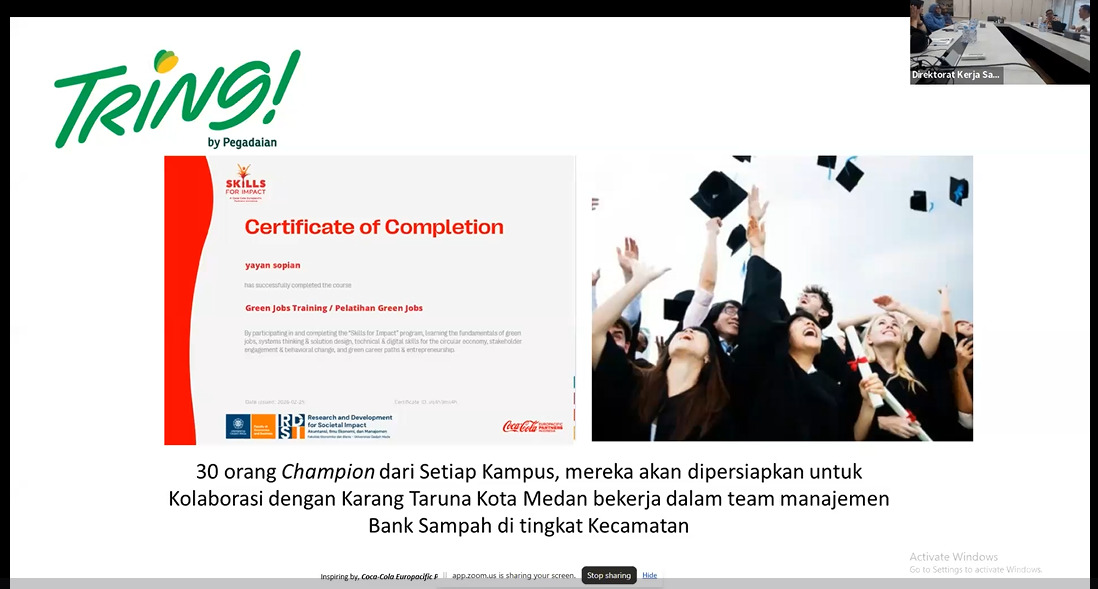
During the meeting, both parties discussed potential collaboration focusing on student capacity development through the integration of green skills, strengthening the role of universities in supporting the circular economy, and empowering communities around the campus.
The presentation delivered by CCEP Indonesia emphasized the importance of developing green talent, which currently faces a gap between industry demand and workforce availability. Universities are considered to have a strategic role in bridging this gap through the integration of learning and practical experience for students.
In addition, CCEP Indonesia outlined its commitment to sustainability through the “This is Forward” initiative, which includes business decarbonization, water and environmental stewardship, packaging circularity optimization, and local community empowerment.
The proposed forms of collaboration include sustainability-themed studium generale programs, thematic community service (KKN) focused on MSME assistance and waste management, integration of the “Skills for Impact” module into the MBKM curriculum, as well as community-based MSME empowerment programs. These initiatives are designed to be integrated with the academic calendar while providing hands-on experience and certification for students.
On this occasion, the Director of DIKG USU, Prof. Dr. dr. Dewi Masyithah Darlan, stated that USU welcomes this collaboration initiative as a strategic step in enhancing the quality of its graduates.
“USU is committed to continuously strengthening the relevance of higher education to industry needs and global challenges. Collaboration with CCEP Indonesia presents an important opportunity to integrate green skills into the learning process, while also providing real-world experience for students in sustainability issues,” she stated.
Meanwhile, Yayan Sopian, Regional Public Affairs Manager of CCEP Indonesia, emphasized that partnerships with universities are a key part of the company’s strategy in creating sustainable impact.
“We see universities as strategic partners in preparing future-ready generations. Through programs like Skills for Impact, we aim to provide learning access, practical experience, and opportunities for students to be directly involved in developing the circular economy and empowering MSMEs,” he said.
.jpeg)
As a follow-up, both parties agreed to initiate the collaboration through the drafting of a Memorandum of Understanding (MoU), which will be followed by Cooperation Agreements (PKS) at the faculty and study program levels. Further meetings will also be scheduled to refine program concepts, including the development of learning objectives aligned with both academic and industry needs.
This collaboration is expected not only to benefit students but also to create sustainable impacts for society and the environment, in line with USU’s commitment to supporting sustainable development.